
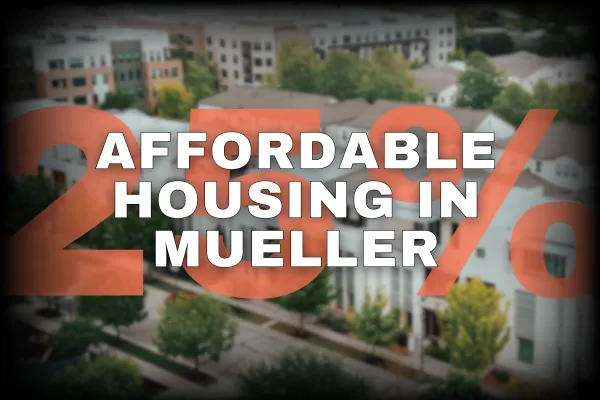
25% of Mueller Housing Stays Permanently Affordable
If you've walked or biked through Mueller, you've passed affordable housing without realizing it. That's not an accident. It's the point. A full 25% of the housing in our neighborhood, both rental and for-sale, is designated permanently affordable, and it's built to look exactly like everything else around it.
As someone who has lived here since Mueller's earliest development, I get asked about this program more than almost anything else. So let's talk about how it started, who it actually serves, and what happens to it as our neighborhood finishes building out.
How a Closed Airport Became a Blueprint for Integrated Housing
This commitment didn't come from a government mandate tacked on after the fact. It goes back to the community planning process that followed the relocation of Austin's original airport. When that land became available for redevelopment, the surrounding neighborhoods had real input into what got built. Some of those communities pushed hard for housing at specific price points, and what came out of that process was a commitment to keep 25% of Mueller's housing affordable - not for five years, not for ten, but permanently.
We're now trying to keep 25% in perpetuity.
That word - perpetuity - is the whole story. A lot of affordability programs around the country sunset after a fixed term, and once the obligation expires, those units convert to market rate. Mueller's mandate is designed to hold no matter how much the surrounding values climb.
Who Actually Lives in the Affordable Units - and Where
The people using Mueller's affordable housing aren't some abstract demographic. They're teachers, nonprofit employees, municipal workers, and grocery store employees - the workforce that keeps a city running, and the same workforce that typically gets priced out of desirable, walkable neighborhoods as those neighborhoods mature.
What sets Mueller apart structurally is that these homes aren't clustered off to one side. Affordable units sit right alongside market-rate single-family homes, townhomes, and condos across our 720 acres, with zero architectural difference between them.
You wouldn't be able to know that that was low-cost housing.
That's not a small design detail. In a lot of cities, affordable housing is visually and spatially set apart from market-rate development, which reinforces stratification and can stigmatize the people living there. Mueller was built so that distinction simply doesn't exist.
A Price Premium That Coexists With Affordability
Mueller does command higher prices than a lot of surrounding Austin neighborhoods. Walkability, density, and proximity to downtown, the university, and the airport all drive that demand.
Yes, you pay for proximity to people and amenities.
That demand held up even through Austin's broader market correction since 2022 - Mueller weathered that period better than many other parts of the city, though I'd want to pull the specific numbers before putting a hard figure on it. If you want the latest local data, I break it down every month in my Mueller Market Updates.
This raises a question housing economists have debated for years: can market appreciation and a permanent affordability commitment coexist long-term in the same neighborhood? Mueller's experience says yes - at least under the right structural conditions. I don't think the affordability program suppresses our desirability at all. If anything, the economic diversity it creates is part of the community character buyers are willing to pay a premium for.
From Affordable Entry to Market-Rate Ownership
One of my favorite parts of this program is watching it work as a stepping stone. I had a client who entered Mueller through the affordable program while working for the university. She saved over time and later purchased a market-rate home of her own.
What it did was allow my client to save her pennies, and get into a market-rate home later on. There are really cool success stories like that all over the neighborhood.
What Happens as Mueller Approaches Buildout
Mueller is nearly at full buildout - there are only a handful of new construction units left. That means the resale market is going to increasingly define how our neighborhood evolves from here. My business partner Ashley Jackson and I focus exclusively on this market at Mueller Residential Group, which gives us detailed, day-to-day knowledge of the neighborhood's housing programs, builder history, and community dynamics.
Whether the affordability mandate keeps functioning as intended under resale-dominated conditions is worth watching closely. The structural commitments are in place, but their durability will be tested as turnover increases and Mueller shifts from a planned development into an organically evolving neighborhood. I'll be covering that shift as it happens.
Featured in Real Estate Today
I was recently featured in a story on this exact topic, published by Real Estate Today, digging into how Mueller's affordability model works and what it means for the neighborhood's future.
Read the full feature here: In Austin's Mueller Neighborhood, 25% of Housing Stays Permanently Affordable – and Invisible by Design