
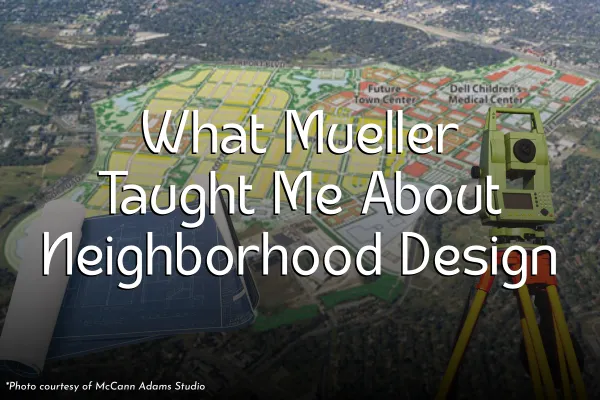
What Living in Mueller Taught Me About Neighborhood Design
Before I moved to Mueller, I didn't spend much time thinking about things like street design, sidewalks or how close a neighborhood's parks and businesses were to one another.
I knew whether I liked living somewhere, of course. But I wasn't necessarily thinking about why certain places were easier or more enjoyable to live in than others.
Nearly 18 years in Mueller has changed that.
I've since learned that some of the smallest design decisions can make an enormous difference in how you experience a neighborhood.
My Previous Neighborhoods Taught Me What I Didn't Want
I've lived in a few places that gave me very different experiences with walkability.
I spent my formative years in the Dallas suburb of Garland, which is essentially a series of highways and byways that snake around houses and businesses with the ultimate goal of leading you back to Dallas. While my little neighborhood had sidewalks and relatively calm streets, there wasn’t really anything to walk/cycle to. My parents are avid walkers, but they performed the majority of their walking regimen by getting in the car and driving 10 miles to the closest mall. You know, the typical American Suburban life.
After that, my story goes much the same way many people who go off to college in a “college town” goes. Studying in Norman, Oklahoma, I lived close enough to campus that walking was part of everyday life.
Then I moved to Plano. I’ll generously leave my description as, “not walkable”.
Then came my move to Austin. My first apartment here was off McNeil, where the only place I could really walk to was Sonic. Which is fine if you want Sonic (which, I did. Often), but not particularly useful for much else.
Later, I lived near South Congress and Oltorf. There were restaurants and bars technically within walking distance, but it wasn’t always a pleasant or safe walk - because it wasn’t designed to be.
And there certainly weren’t staples readily available by foot. Just getting to the grocery store involved crossing a busy intersection that I didn't feel particularly comfortable navigating in a car, let alone by foot.
So, despite living somewhere that technically had destinations nearby, I still drove almost everywhere.
That experience helped me appreciate something about Mueller that I didn't fully understand when I first moved here.
A neighborhood isn't really walkable just because there are things nearby. You have to be able to comfortably get to them.
What Actually Makes a Neighborhood Walkable?
When people ask me what walkability means, my first answer is proximity.
Can you get to the things you need without traveling very far?
That might mean a grocery store, a restaurant, a park, a dentist or somewhere to get your hair cut, etc…
But proximity alone isn't enough. You also need sidewalks that actually connect. Not a sidewalk on one block that suddenly disappears on the next.
I love that Mueller has tree lawns, those strips of landscaping between the sidewalk and the street. They create a little separation from traffic, and as the trees mature, they provide much-needed shade during Austin summers.
Street width, vehicle speeds and intersections matter too.
The whole experience should make walking, biking or rolling somewhere feel like a practical choice rather than an obstacle course.
And the more of your everyday needs you can meet close to home, the more useful all of that infrastructure becomes.
I Wasn't Entirely Sold on Density at First
One of the things I was initially skeptical about when I moved to Mueller was how close the houses were to one another.
I'd never lived in a neighborhood designed quite like this.
Would it be loud? Would it feel crowded? Would there be enough space?
As it turns out, I love it.
When you live close to your neighbors, you don't have to travel very far to see your friends. You run into people. You can walk to someone's house or meet up in a nearby park.
In early Mueller, that closeness helped create an incredibly tight community.
From minor inconveniences to tragedies, from major celebrations to a random Tuesday, the closeness of the community was/is fostered first by the literal closeness of our day to day lives.
I’ve written before about how neighbors stepped in to help me in the aftermath of a hailstorm in 2008. That was one of my first lessons in the benefits of living in close quarters. But there were also Wine Wednesdays because “the Wedge” pocket park was right in front of those families houses. There were supper clubs because walking half a block to your neighbor’s house was infinitely easier than trying to park downtown.
Of course, density isn't just about how close the houses are.
It's also about having enough people living nearby to support the restaurants, shops, services and other amenities that make a neighborhood more self-sustaining.
Mueller was masterfully planned with different levels of density throughout the development.
Not Every Part of Mueller Was Designed the Same Way
One thing I find interesting about Mueller is how the housing changes as you move through the neighborhood.
Around portions of the perimeter, you'll find larger detached houses on larger lots.
As you move closer to the town center, you see more townhomes, row homes, apartments and buildings with commercial space on the ground floor.
That wasn't an accident.
The original development plan anticipated higher density around the town center, with a variety of housing types throughout Mueller.
And the plans evolved over time.
As development progressed, planners made adjustments to allow more density in certain areas. The neighborhood continued to change as they learned what worked and what could be improved.
Today, you can see the results of those decisions in the different sections of Mueller.
You can also see how important it is to design the streets and infrastructure to support the number of people living here.
There Are Still Things I'd Change
I love Mueller, but that doesn't mean I think every design decision was perfect.
I'm proud to say I've helped lead the charge for safer speed limits, but our some of our intersections could work better, especially in areas with heavy pedestrian activity.
The intersection around Aldrich Street and McBee is one example. It's a busy area with people walking between restaurants, businesses and other destinations, and the intersection can be confusing.
I'd love to see opportunities for making parts of that area more pedestrian-oriented, even if it were only during certain times.
Parking is another challenge.
Our narrower streets work well when people follow the parking rules. When they don't, it can create problems for larger vehicles, including trash trucks trying to navigate corners.
If I could wave a magic wand, I'd have fewer cars parked on the streets.
Or maybe just fewer cars. A gal can dream, right?
The point is that neighborhood design doesn't stop being important once the construction crews leave. The way people use those spaces matters too.
The Best Part Is How It All Works Together
When I moved here in 2008, Mueller was still a relatively small collection of homes surrounded by construction.
We didn't have all the restaurants, shops, parks and services we have today.
I remember once protesting my property taxes and arguing that the neighborhood didn't have all the amenities we'd been promised yet.
That argument didn't get me very far. However, fast forward nearly two decades and most of those things have arrived.
The trails connect around the neighborhood. We have parks throughout Mueller. There are restaurants, shops, services and places to gather.
I can meet so many of my everyday needs without leaving the neighborhood.
And what surprises me most is how well it all came together.
I originally moved to Mueller because I wanted to live somewhere different. I liked the idea of the neighborhood and what it was supposed to become.
I didn't fully understand how much the design of a place could influence everyday life. Now I do. And I love this life!
Good neighborhood design isn't just about where you put the streets, houses and parks. It's about what those decisions make possible for the people who live there.